
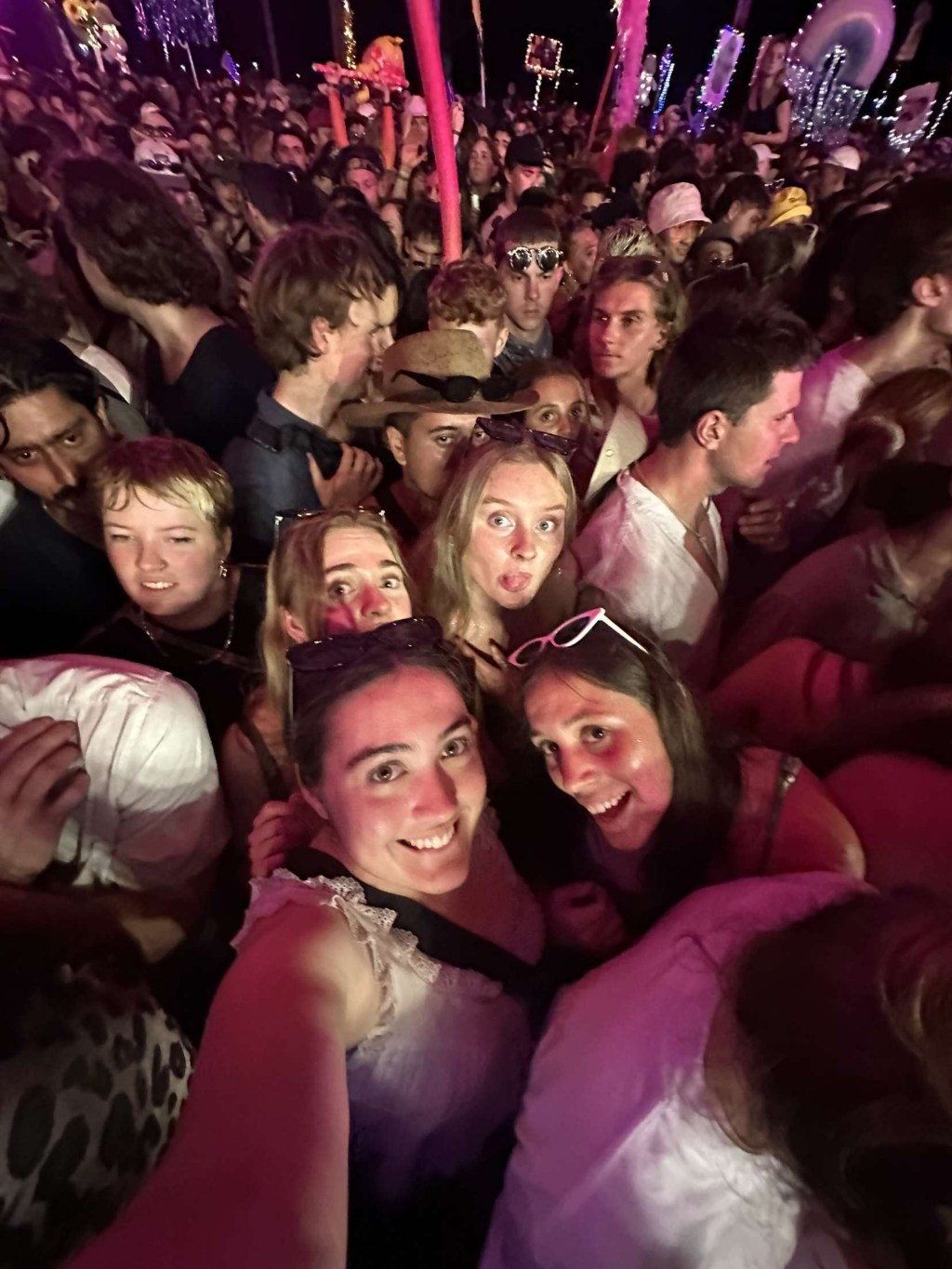
(Featured image provided by anonymous survey participant)
The Party’s Over? Understanding the Diverse Social Preferences of University Students
When I was freshly 18 and in my first year of university I really enjoyed going out to the local clubs and having some drinks with my friends, feeling the euphoria and dancing the night away. However, once I reached my second year of university I no longer felt that euphoria when going out and the binge drinking was no longer worth the repercussions of feeling unwell and tired the next day. So, I began to wonder are other students feeling the same way I am.
The nightlife in Wollongong is particularly popular as excessive alcohol consumption is a prevalent cultural factor among students at Australian universities (Davidson et al. 2022). That is why I conducted a survey asking a convenient sample of university students, to explore their attitudes towards clubbing and drinking.
In Australia, alcohol consumption is deeply ingrained in social gatherings and celebrations (Rahman, Sofija & Sebar 2022). However, drinking habits have noticeably changed throughout generations. While ‘boomers’ were known for their heavy drinking, millennials have shown to be more selective with their drinking habits and engage in less binge drinking. (Burgess, Yeomans & Fenton 2022). Studies have shown a significant reduction in alcohol consumption among young Australians since the early 2000s (Mojica‐Perez, Callinan and Livingston, 2020). However, I wanted to observe if this was true among current university students.
Is alcohol consumption a concerning factor for students?
One potential explanation for the decline in alcohol consumption among young adults could be the growing emphasis on health consciousness and an increased understanding of the dangers associated with risk-taking behaviours (Rahman, Sofija & Sebar 2022).
Understanding why young adults abstain from drinking is crucial, as it can allow us to create other social activities that are inclusive and exciting for young people. This knowledge can help communities and government bodies support the youth in social contexts where alcohol consumption is common (Rahman, Sofija & Sebar 2022). Therefore, this study is essential for developing social policies and support systems that are relevant to young people’s needs as they manoeuvre their way through various social interactions within modern society. This has been recently established in Victoria, where the recognition of drinking culture has led to initiatives such as the alcohol culture change project, which implements youth-orientated community activities that aim to reduce alcohol-related harm (Murphy & Ollerenshaw 2022).
That is why I asked the survey participants what other social activities they enjoy, to uncover other social activities that would be inviting for young Australians; the responses included:
- Sports
- Going for a walk
- Going out for dinner
- Music events
- Theatre performances
- Games nights
- Movie nights
- Bowling
- House parties
- Escape rooms
- Karaoke
- Pool
- Mini Golf
- Paint and sip
- Art shows
In my survey, I asked participants if they drink alcohol when they go out. A 60% majority said yes, with 30% saying sometimes and 10% stating no.
To explore whether health concerns influenced their decision to drink, I asked if they were aware of the health impacts of alcohol consumption. 30% stated they were extremely aware, with 55% stating they were very aware, and 15% they were only somewhat aware. Building on this, I inquired whether personal health considerations influenced their choice to drink or not. Only 30% stated yes, while 40% stated sometimes and the other 30% claimed no. Looking at these results and my small participant pool, I don’t believe an accurate conclusion about whether health concerns influence student’s drinking habits can be made from these results.
So, what were the results?
To reiterate, this participant pool consisted of students in Wollongong aged 19-23 years old. In the survey, I began by asking the students if they enjoyed clubbing: 35% said yes, while 50% said only sometimes and only 15% said no, with one participant stating they “don’t enjoy it at all”. Interestingly, when asked if they frequently go out clubbing, 45% said no, 40% stated they only go out occasionally and 15% said that they do go out frequently. Thus, suggesting that whether a student enjoys going out or not is not the only factor that influences how often they go out. Then, when asked if they would like to go out more or less than they currently are, the responses were once again varied. Once again, these results highlighted that this is not enough data to make meaningful comments on.
To try to further my understanding of the current clubbing environment, I asked the students if their clubbing experience has changed over the years. The responses were either a simple yes or no because they never liked it. Finally, I asked if they think young people socially benefit from clubbing, once again the opinions varied between yes, no and sometimes. This led me to realise that this topic was more complex than I originally thought.
Although this study aimed to comprehend the intricacies of youth culture and social preferences in the contemporary Australian setting it has revealed the complexity and diversity of student experiences. As a result, I feel no closer to understanding youth culture as there is no clear consensus as to whether contemporary students enjoy clubbing or not, and it remains unclear if there is a significant reduction in alcohol consumption among young Australians. This uncertainty reveals the need for further research to gain a deeper understanding of youth culture and social behaviours.
My reflection:
Conducting research on youth culture and social preferences, particularly regarding clubbing and alcohol consumption, presented several challenges and learning experiences. My journey through this research process highlighted the complexities and nuances of gathering data, ensuring ethical practices, and interpreting diverse responses.
To begin with I found it challenging to gather survey responses as I was away during the week everyone else uploaded their surveys in class. This made it difficult to collect enough responses that would give me enough data to analyse, given that our participant pool was limited to the current BCM212 student cohort. It would have been more effective to survey all students, not just those from BCM212 so that I could analyse a larger and more representative sample.
Additionally, the research process was stressful as I was concerned about accidentally acting unethically or offending my survey participants. To avoid this I ensured that everyone understood what the study consisted of and acquired their consent. I also made certain that everyone who participated in this survey was over the age of 18 as the questions involved discussions about clubbing and alcohol consumption. Further, before handing out my surveys, Wren reviewed my questions to ensure they were appropriate and would not make anyone feel uncomfortable.
To further my understanding of young people’s attitudes towards clubbing and drinking, I would have liked to do an additional survey that asks more specific and detailed questions about individual experiences and the reasonings behind their opinions.
I am also curious as to whether the survey results would differ in various regions of Australia, to observe if there are any differences or similarities between rural areas and major cities. I think that this topic would provide more insight if conducted on a larger scale.
Overall, from this research experience, I learned that a simple survey is not enough data to make a definitive conclusion about such a complex topic. Before conducting my research I believed that the results would leave me with a definitive answer either proving or disproving that young Australians are drinking and going out less, however, this was not the case. The diverse range of responses highlighted the complexity of youth and social behaviours and emphasised the need for more extensive research to understand these dynamics.
References:
Burgess, A, Yeomans, H & Fenton, L 2022, ‘“More options…less time” in the “hustle culture” of “generation sensible”: Individualization and drinking decline among twenty-first-century young adults’, The British Journal of Sociology, vol. 73, no. 4, pp. 903–918, viewed 11 April 2024, <https://doi-org.ezproxy.uow.edu.au/10.1111/1468-4446.12964>.
Davidson, L, Mefodeva, V, Walter, Z & Hides, L 2022, ‘Student perceptions of the current drinking culture in three Australian residential colleges: Drinking motives, consequences and recommendations for harm minimisation strategies’, Drug and Alcohol Review, vol. 42, no. 1, viewed 11 April 2024, <https://doi-org.ezproxy.uow.edu.au/10.1111/dar.13540>.
Mojica‐Perez, Y., Callinan, S. and Livingston, M. (2020). Examining beverage‐specific trends in youth drinking in Australia before and after the implementation of the alcopops tax. Drug and Alcohol Review, 39(3), pp.246–254, viewed 11 April 2024, <https://doi.org/10.1111/dar.13038.>
Murphy, A & Ollerenshaw, A 2022, ‘A community‐wide approach to reducing risky drinking cultures in young people in rural Australia’, Australian Journal of Rural Health, vol. 31, no. 2, viewed 11 April 2024, <https://doi-org.ezproxy.uow.edu.au/10.1111/ajr.12936>.
Rahman, N, Sofija, E & Sebar, B 2022, ‘“I Just Don’t Drink”: Examining the Experiences of Young Adult Abstainers in Australia’s Changing Drinking Trends’, YOUNG, vol. 31, no. 1, p. 110330882211112, viewed 11 April 2024, <https://doi.org/10.1177/11033088221111221>.
Get in Touch
mayacassar@live.com
0488 660 452
 MayaCassar.Blogs
Leave a comment