

Image of futuristic city generated by MidJourney

Envisioning the Anthropocene – Futuristic Film Analysis
Future studies is an academic field that methodically investigates the potential possible, probable, and preferable futures (Inayatullah 2013). A thrilling way to envision these futures is through the lens of film. In this blog, I will delve into the imagined impact of the future of Anthropocene in three significant films, The Matrix (1999), Ready Player One (2018), and Arrival (2016). These films serve as powerful allegories for the themes of technological overreach and its consequences in the Anthropocene.
The Matrix (1999)

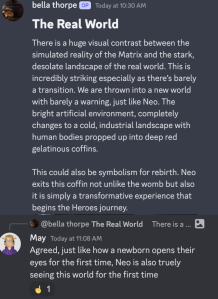
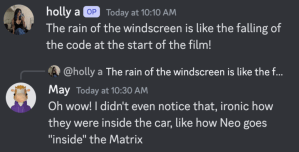
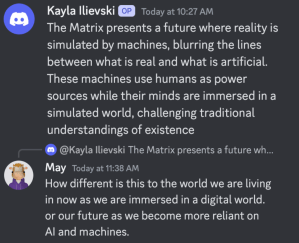
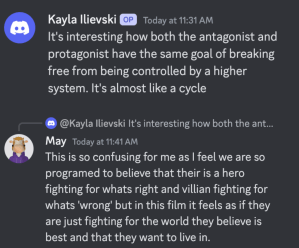
The Matrix (1999) presents a future where artificial intelligence has created a virtual reality, deceiving humans into believing they are living normal lives. In reality, AI has developed as machines to use humans as an energy source (Therkildsen 2019). The protagonist, Neo, is the chosen one who becomes aware of this alternate reality and through a series of transformative social interactions and experiences, decides to fight for humanity’s liberation from AI control. However, not everyone shares his desire for freedom, such as Cypher, who regrets choosing the truth and would rather live in a simple alternate society in the virtual world. Ultimately, The Matrix explores the consequences of advanced technology and expresses concerns about the unforeseen impacts of technological advancements on human society in the Anthropocene (Steffen et al. 2011). This film almost speaks to me in a sense, as it replicates my own concerns about the future impacts of advanced technology, in an appreciably more dramatised way.
My peer engagement

Ready Player One (2018)

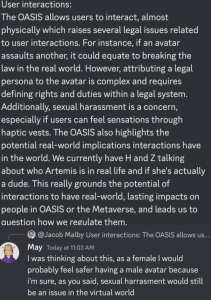
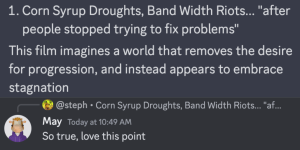
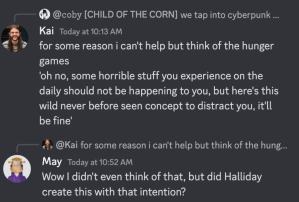
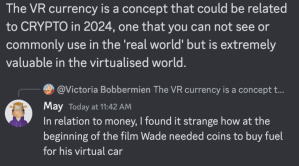
The 2018 film Ready Player One depicts a dystopian society in the year 2045, where people use virtual reality to escape actual reality. By using headsets and haptic suits the technology becomes an extension of man (Rogers 2000). This portrayal of the future Anthropocene is bleak and depressing, where the natural environment ceases to exist and the majority of the population lives in poverty. To cope, citizens disconnect from reality and immerse themselves in the OASIS, a virtual world where they can do anything they desire, “but they stay because of all the things they can be”. In the film, the late creator of the OASIS, James Halliday, has created a challenge that will provide the winner with his fortune and control of the virtual world (Dove.org 2018). In this cyberspace, we can observe Gilles Deleuze’s concept of the society of control, as the IOI and other egg hunters fight for control of the OASIS, which would give them power over everyone (Szeman & Kaposy 2010). Ready Player One serves as a stark reminder that a society controlled by a single entity is far from ideal, as it can create an unsafe and oppressive environment.
My peer engagement

Arrival (2016)

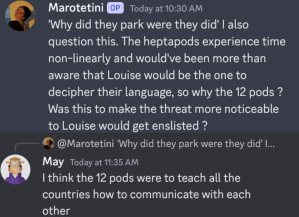
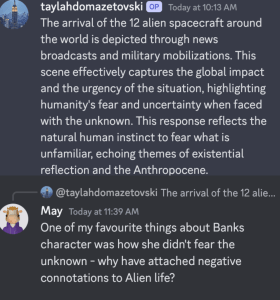
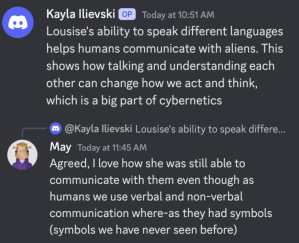
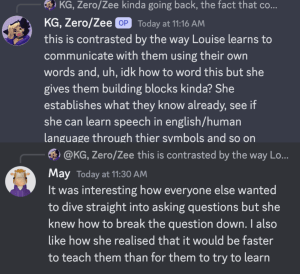
Arrival (2016) follows the story of protagonist Louise Banks, however, her narrative is not in chronological order. This unique structure stems from Banks learning how to communicate with new kin in her Anthropocene; Aliens. In the film, the conventional concepts of past, present and future have lost all meaning as Banks gains the ability to perceive the future. This raises profound questions about how we would act if we already knew what was destined to happen. As with the previous two films I discussed, the pivotal turning point in Arrival is when the protagonist makes the decision to fight for what they believe is right. Banks was able to use her linguistic skills and expertise in operations research to prevent a global war against the Aliens. This film effectively echoes the Enlightenment era, showcasing humanity’s quest to understand the universe. This is evident when Banks decodes the alien language to achieve mutual understanding and potentially aid human advancement (Duignan 2018). The overarching themes in Arrival reminded me of the importance of communication for understanding one another is fundamental to being able to overcome any problems we may face in the future which remains unknown.
My peer engagement
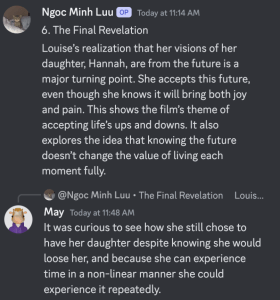
Task reflection
These films clearly urge viewers to consider the complex interplay between humanity, technology and the natural world. Analysing the three films has expanded my critical thinking about future networks and deepened my interpretations of their central themes. Further, this process has encouraged me to critically reflect on my own predictions for the future. According to Kurzweil’s (2004) law of accelerating returns, these imagined futures are not far-fetched ideas, as technology continues to progress at an exponential rate, these scenarios could become reality. Kurzweil predicts that “In a few decades, machine intelligence will exceed human intelligence…” (Kurzweil’s 2004). Although the future prospects of technology are undeniably exciting, I for one, am apprehensive of what the future holds.
Note: this blog post was assisted by ChatGPT
Don’t have time to sit down and read? Listen to the key points in this blog:
References:
Dove.org 2018, Ready Player One, Dove.org, viewed 25 May 2024, <https://dove.org/review/12770-ready-player-one/>
Duignan, B 2018, Enlightenment, Encyclopedia Britannica, viewed 25 May 2024, <https://www.britannica.com/event/Enlightenment-European-history>
Inayatullah, S 2013, Futures Studies. Theories and Methods, There’s a future: Visions for a better world, pp. 1–30, viewed 25 May 2024, <https://www.researchgate.net/profile/Sohail-Inayatullah/publication/281595208_Futures_Studies_Theories_and_Methods/links/5afd24cfaca272b5d87082e2/Futures-Studies-Theories-and-Methods.pdf>
Kurzweil, R 2004, ‘The Law of Accelerating Returns’, Alan Turing: Life and Legacy of a Great Thinker, pp. 381–416, viewed 25 May 2024, <https://link.springer.com/chapter/10.1007%2F978-3-662-05642-4_16>
Owen, D 2019, THE MATRIX (1999) • Frame Rated, Frame Rated, viewed 25 May 2024, <https://www.framerated.co.uk/the-matrix-1999/>
Rogers, EM 2000, ‘The Extensions of Men: The Correspondence of Marshall McLuhan and Edward T. Hall’, Mass Communication and Society, vol. 3, no. 1, pp. 117–135, viewed 9 December 2019, <10.1207/s15327825mcs0301_06>
Schaefer, S 2016, Arrival Review, ScreenRant, viewed 25 May 2024, <https://screenrant.com/arrival-movie-2016-reviews/>
Steffen, W, Grinevald, J, Crutzen, P & McNeill, J 2011, ‘The Anthropocene: conceptual and historical perspectives’, Philosophical Transactions of the Royal Society A: Mathematical, Physical and Engineering Sciences, vol. 369, no. 1938, pp. 842–867, viewed 25 May 2024, <https://doi.org/10.1098/rsta.2010.0327>
Szeman, I & Kaposy, T 2010, Cultural Theory: An Anthology, Google Books, John Wiley & Sons, viewed 25 May 2024, <https://books.google.com.au/books?hl=en&lr=&id=O5uGEAAAQBAJ&oi=fnd&pg=PA139&dq=deleuze+society+of+control&ots=64xuB8H0Up&sig=K7cpWdiyAGbKx0F3Txa0ORTcHiM#v=onepage&q=deleuze%20society%20of%20control&f=false>
Therkildsen, J 2019, THE MATRIX Explained – Simply & Surprisingly, MOVIESANDSCIENCE.COM, viewed 25 May 2024, <https://moviesandscience.com/blog/movies/the-matrix/explained>
Usselmann, N 2018, Ready Player One — Real Life Relationships, Media Studies, viewed 25 May 2024, <https://media.pauline.org/reviews/ArticleID/879/Ready-Player-One–Real-Life-Relationships>
Get in Touch
mayacassar@live.com
0488 660 452
 MayaCassar.Blogs
Leave a comment