

Medical Media Mission: Contextual Report – Part 2
This contextual report will discuss the development and reframing of my digital artefact Medical Media Mission. Medical Media Mission began as an accessible online web platform that acted as a safe, private, digital space where people could talk openly about anything related to medicine. Unfortunately, there are too many stories of people losing their lives due to medical neglect. It’s also expensive to undergo multiple tests only to be left without answers. Medical Media Mission aims to reduce the time and money spent on endless doctor visits, helping people get better faster.
Medical Media Mission has since been reframed and now acts as a safe space for women to discuss rare, complicated or undiagnosed medical concerns anonymously specifically related to their reproductive health. Many women face serious reproductive health issues that go unresolved, often without clear answers or proper care from medical professionals. This mistreatment is not only emotionally taxing but also life-threatening. Medical Media Mission is a tool that advocates for women’s health by raising awareness of these challenges and striving to make meaningful changes for all women receiving medical care.
Project Pitch Review with Fletcher and Charlee – Part 2:
- Fletchers DA: Trying To Talent
- Charlees DA: Thrift with Charr
(For Part 1 click here)
Contextual Report
What is Medical Media Mission?
Medical Media Mission is an accessible online web platform that acts as a safe space for women to discuss rare, complicated or undiagnosed medical concerns anonymously specifically related to their reproductive health. Many women face serious reproductive health issues that go unresolved, often without clear answers or proper care from medical professionals. This mistreatment is not only emotionally taxing but also life-threatening. Medical Media Mission is a tool that advocates for women’s health by raising awareness of these challenges and striving to make meaningful changes for all women receiving medical care.
The human body is complex and every individual is unique, therefore it can be challenging for people to find answers about why they feel unwell or discover treatments that work for them. That is why I created Medical Media Mission – a safe, private, digital space where people can talk openly about anything related to medicine.
Discussion topics can include:
- Symptoms someone is experiencing
- Medical treatments and medications people have tried
- Recommending tests and scans
- Suggestions for specialists and practitioners
- Sharing advice and support
- Asking other general questions


My Story
I came up with the idea for Medical Media Mission as when creating this project I knew it had to be something I was passionate about. Growing up I spent a lot of time in practitioners’ offices and the surgical wards. Having had a lot of random ailments and injuries that weren’t common, I found the hardest part was finding answers as to what was wrong with me. The other aspect of my journey that was difficult is that no one around you understands what you are going through. Although someone can google search their symptoms, the results are often unhelpful, either telling you everything’s fine or suggesting something as extreme as cancer, which leaves you more frustrated than informed. This is why I started Medical Media Mission. I wanted to build a space where people who feel unheard by medical professionals can share their stories, ask questions, and find answers. Unfortunately, there are too many stories of people losing their lives due to medical neglect. It’s also expensive to undergo multiple tests only to be left without answers. Medical Media Mission aims to reduce the time and money spent on endless doctor visits, helping people get better faster. Another important aspect is that sometimes the only people who truly understand what you’re going through are those who’ve been through it too. This platform provides a space for people to give advice, share experiences, and offer support. Medical Media Mission is a platform I wish I had when I was going through my medical journey. It is my goal to give people a voice who feel they aren’t being heard.
Media Influences
When envisioning the look and feel of Medical Media Mission, I drew inspiration from Reddit—a platform where communities gather to explore shared interests, hobbies, and passions. However, I wanted my platform to have a clear focus on healthcare. Initially, I pitched the idea of making Medical Media Mission a website, but I was worried that it might come across as too formal or intimidating for users. To address this, I shifted towards designing an app, thinking it would feel more casual and accessible, similar to opening Instagram on your phone. Unfortunately, the costs of publishing the app were too high, and I realised that using an app requires more effort for the user such as downloading, signing in, and verifying their details. Despite liking the app design, I decided to return to the website format. However, my first draft of the website felt too sterile and clinical like a medical practitioner’s site, which wasn’t the vibe I was aiming for. I wanted a visually clean and welcoming platform, so I drew inspiration from health apps like Flo and Clue, which focus on period tracking. In the second version of the website, I incorporated soft, pastel colours to create a calming atmosphere and structured the site like a blog for a more relaxed tone.



Subject matter – Social Utility
Medical Media Mission is used to connect individuals experiencing complicated or undiagnosed medical concerns, specifically within women’s reproductive health, and a supportive community that understands their challenges. By offering an accessible, anonymous space for women to share their stories, ask questions, and seek advice, the platform fosters the formation of relationships based on shared experiences. These relationships help create a sense of belonging and understanding, as women who may have felt isolated due to their medical challenges can now connect with others who face similar issues. The feedback loops within the platform are crucial to its utility. Users not only receive support and insights from others but also contribute to the collective knowledge base. This exchange of information such as sharing medical treatments, symptoms, or specialist recommendations. This builds a dynamic flow of feedback that evolves as more stories and experiences are shared. Over time, these interactions can lead to new ways of approaching medical challenges and even generate insights that were previously overlooked, ultimately strengthening the platform’s value and impact. By repurposing existing online forums and technologies for a new purpose, Medical Media Mission has the potential to drive change in how women advocate for their health, offering both emotional support and practical advice. The more women contribute and interact, the stronger the platform becomes, amplifying its ability to improve the health journeys of countless individuals.
To build trust with the audience, it’s important to highlight that the website is actively monitored by me to ensure a safe and supportive environment. Every post is carefully reviewed and must be approved before being published, maintaining the quality and accuracy of the discussions. Additionally, all posts remain completely anonymous, protecting users’ privacy and ensuring they can share their experiences and concerns without fear of judgement or exposure.
Target Audience
The target audience for Medical Media Mission primarily consists of women aged 11 to 50, which aligns with the medically defined childbearing age range. This age group includes a diverse population experiencing various stages of reproductive health, from puberty to menopause, and faces a range of medical concerns, whether common or rare, diagnosed or undiagnosed. The platform caters to women who feel unheard or neglected by the medical community, providing a safe, anonymous space where they can openly discuss sensitive and complicated reproductive health issues without judgement. These women may be struggling to find answers through traditional medical channels or feel dismissed by healthcare professionals, making Medical Media Mission a valuable resource. Additionally, the platform is suited for women who may not have access to comprehensive healthcare or those who have experienced frustration in navigating the medical system. It also resonates with those who seek peer-to-peer support, understanding, and shared experiences from others facing similar medical challenges. By focusing on women’s reproductive health, Medical Media Mission addresses a specific need for advocacy, support, and empowerment within this demographic, aiming to raise awareness and create meaningful change in how women are treated and diagnosed in medical settings.

Key Learning Moments – The beginning
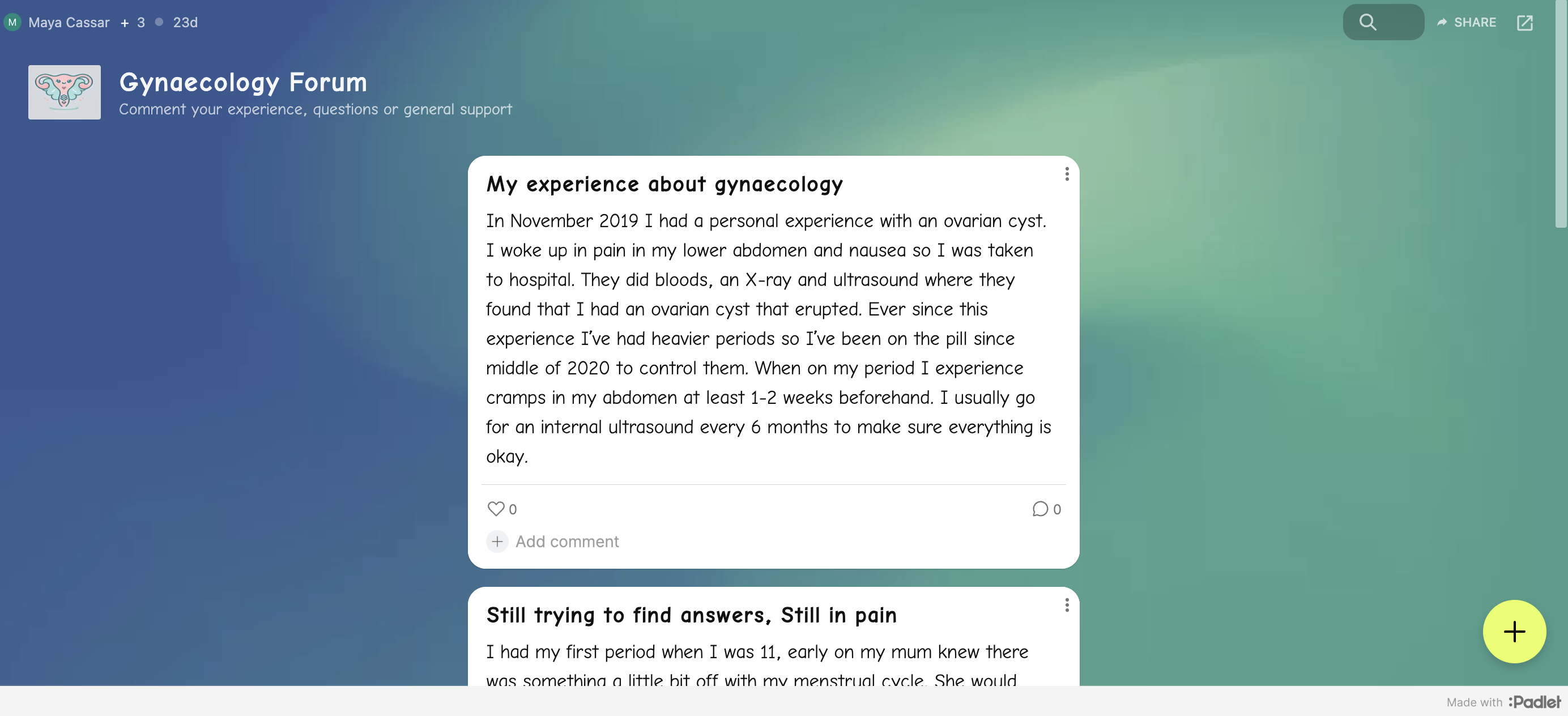
Developing this project was far more challenging than I initially anticipated and involved a lot of trial and error. I kept rethinking both the platform I would use to create my digital artefact and the design, as I wanted everything to be just right. After experimenting with different options, I finally created the website and crafted it exactly how I envisioned it. Each medical specialisation was given its own dedicated page, complete with a brief summary of the topic and a chat forum where users can anonymously ask questions or offer support. To bring this concept to life, I used Padlet to host the discussion boards, which costs $7.99 a month. Additionally, I utilised ChatGPT to generate logo images for each of the 12 medical specialisations and write concise summaries explaining when users should seek professional help. While separating the specialisations into individual pages was a tedious task, the result was well worth the effort, as it made the site more organised and user-friendly.
Strategic Project Development Concepts
So what key techniques has the project utilised?
Medical Media Mission was developed using exaptation. By using chat forums on a website to discuss rare, complicated, or undiagnosed medical concerns, it repurposes existing technology for a new function that goes beyond its original intent. The aim of adapting this technology is to lead to transformative changes in how people seek support, share information about their health, and advocate for how women are treated in the medical industry.
Medical Media Mission is also antifragile as it not only handles the challenges of dealing with rare and complicated medical conditions but also improves because of them. Medical Media Mission is designed for individuals dealing with rare, complicated, or undiagnosed medical concerns as these situations are often filled with uncertainty, stress, and volatility. By providing a platform where users can share their experiences, learn from each other, and potentially discover new treatments or coping mechanisms, the forum will become stronger and more valuable as more people contribute, especially under the stress of uncertainty. Over time, as the community grows and more information is shared, the platform can adapt and evolve based on user interactions. This could involve users developing new ways to approach their health challenges, finding new treatments, or even discovering patterns that were previously unnoticed. The forum’s ability to improve and expand its value through these contributions embodies the concept of antifragility. Further, the medical issues discussed on the platform can be deemed disorderly, often defying easy solutions. However, by bringing people together who have faced these challenges, the forum can potentially generate new insights and solutions that emerge from this disorder, turning it into an asset rather than a liability.
Re-framing
The feedback I received from users of the first version of my website was overwhelmingly positive and many people found it to be an invaluable tool and wished they had access to it during their own medical journeys. However, it was a conversation with a friend that marked a turning point in the project. We discussed how the most visited section of the site by far was the gynaecology category. While this wasn’t surprising, it was deeply saddening to see how many women were navigating these difficult experiences. This conversation made me realise how I could refine the site to make it even more effective. Before this, I had been considering expanding the website by adding more categories, covering each organ, bone, nerve, and system. But as I started implementing this, it quickly felt overwhelming and lacked a clear focus. It didn’t feel like the website was serving a meaningful purpose anymore. Recognising that the gynaecology section was the most popular, I decided to narrow the focus of the project rather than expand it. I chose to reframe Medical Media Mission as a platform specifically dedicated to highlighting the widespread issues women face with reproductive health and the poor treatment they often receive from medical professionals. This shift not only gave the project a clearer purpose but also allowed it to better serve the needs of its users.

The Future of Medical Media Mission
I envision Medical Media Mission playing a pivotal role in reducing the stigma surrounding women’s reproductive health. By fostering open discussions and offering a platform for women to share their experiences, I hope it will help break down the barriers that often prevent these issues from being addressed openly. More than just a support forum, I see Medical Media Mission becoming a powerful tool for education and advocacy, driving meaningful change in how women are treated, diagnosed, and supported in the medical field.
Reflection
Reflecting on this project, I’m incredibly proud of what I’ve built. Medical Media Mission is more than just a website, it’s a digital artefact that I’m deeply passionate about, and it addresses a need I have personally felt throughout my own medical journey. It’s a tool I wish had existed when I needed it, and knowing that it’s now available for others brings me immense joy.
I plan to continue developing and refining this project, expanding its reach, and sharing it with a wider audience. I believe the Medical Media Mission has the potential to make a real difference, both in individual women’s lives and in the broader landscape of women’s healthcare. I’m excited to see how it can continue to advocate for women’s health and contribute to generating positive, lasting change in the way women are treated in medical settings.
References
Dorst, K 2015, ‘Frame Innovation: Create New Thinking by Design’, MIT Press, Cambridge, viewed 24 October 2024, <https://ebookcentral.proquest.com/lib/uow/reader.action?docID=3339962>
Gabora, L. & Ganesh, K. (2020). Exaptative Thinking as What Makes Us Human. In: C. La Porta & S. Zapperi (Eds.) Understanding innovation through exaptation, (pp. 183-192). Basingstoke, UK: Springer-Nature (Frontiers Collection).
Mishra, A, Lin, Z & Chang, X 2015, ‘A cognitive learning approach to solving perceptual problems’, Proceedings of the IEEE International Conference on Big Data (Big Data), IEEE, pp. 2482-2491, viewed 24 October 2024, <https://ieeexplore-ieee-org.ezproxy.uow.edu.au/document/7409948.>

Supporting Media
Get in Touch
mayacassar@live.com
0488 660 452
 MayaCassar.Blogs
Leave a comment